
TL;DR
Start with the battery pack, because it is the highest hidden cost on any used electric cart.
- Date code. Stamped near the terminals, it gives you the pack’s real age rather than the seller’s estimate.
- Resting voltage, battery by battery. A multimeter across each battery at rest, compared against the manufacturer’s own state-of-charge table, gives you its health. Trojan Battery treats a spread greater than 0.15 volts between 6-volt batteries as a sign of a problem.
- The serial number, not the seller’s memory, is what gives you the model year.
- Run that serial against the Consumer Product Safety Commission recall list, because golf car recalls follow the vehicle and the repair is free.
Price the cart on what those four checks say.
The Twenty-Minute Version of a Pre-Purchase Inspection
Most buying guides hand you a forty-point walkaround.
Tires, seats, rust, brakes, and a listen for whines from the rear end. All of it is worth doing, and almost none of it separates a good cart from a bad one, because cosmetic condition is the part a seller already fixed before taking photos. Fresh seats cost a few hundred dollars. A pack does not.
The expensive faults hide in places a walkaround cannot reach.
A pack of six batteries can look immaculate, hold a charge for a lap of the neighborhood, and still be twelve months from a full replacement. A cart can drive beautifully and still be sitting on an unrepaired brake recall. A seller can honestly tell you a cart is a 2019 because that is the year they bought it, when the serial number says 2015.
None of that shows up in a photo set, none of it shows up on a five-minute drive, and all of it moves the price by four figures.
So we do the boring, documentary checks first, and only after that do we walk around the cart.
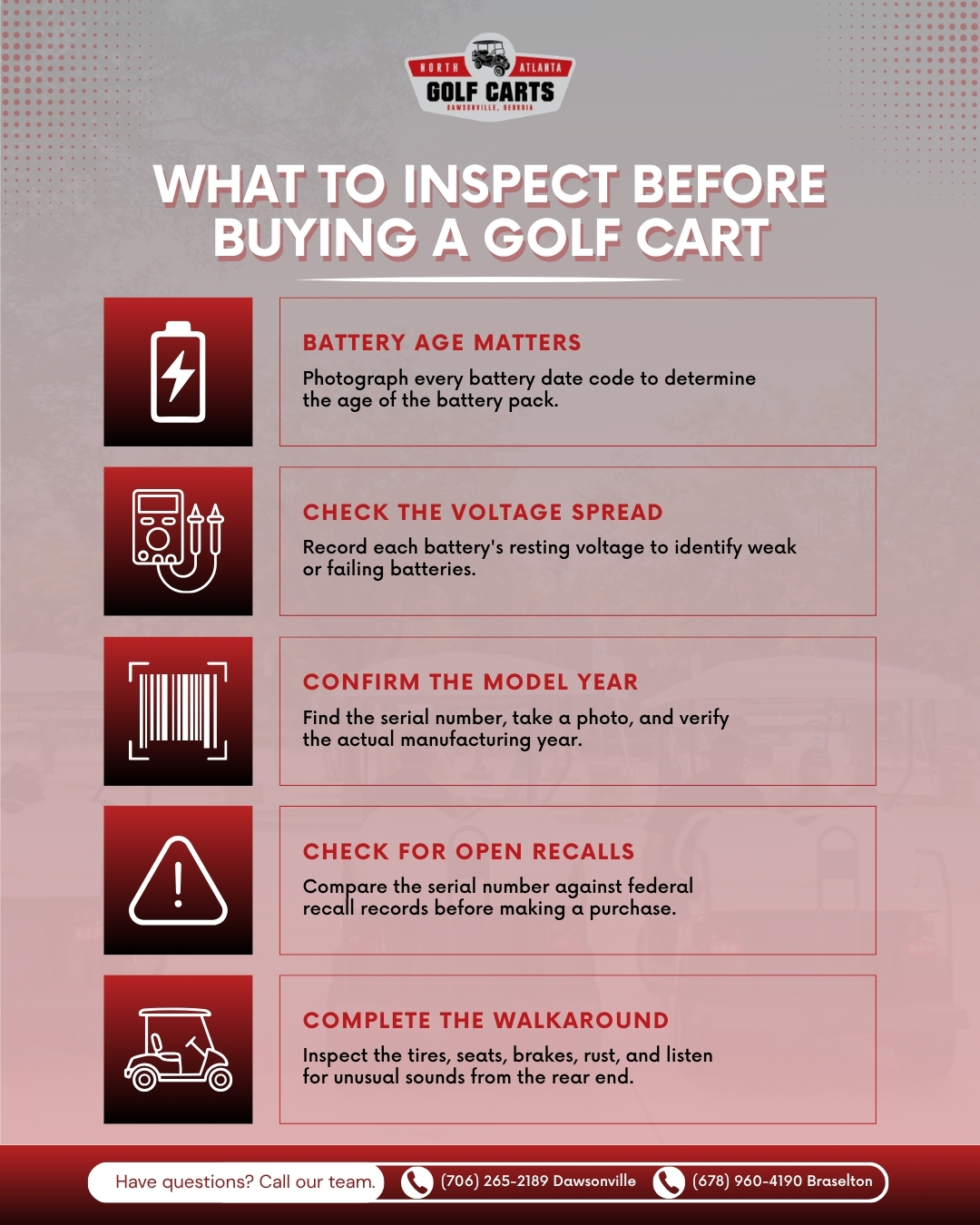
- Photograph every battery date code in the pack
- Read each battery’s resting voltage and write down the spread
- Find the serial number, photograph it, and decode the model year
- Run that serial against the federal recall record
- Then walk the cart: tires, seats, brakes, rust, and listen at the rear end
We run this exact sequence on every trade-in before it joins our used golf carts for sale Atlanta inventory, and it takes one person about twenty minutes.
How Old Is the Battery Pack, Really?
Read the date code.
On flooded lead-acid golf car batteries, the manufacturer stamps the month and year of manufacture directly onto a terminal or the cover beside it, so the pack’s age is a fact you can see rather than a number the seller estimates. Trojan Battery’s own FAQ puts the code on the negative terminal as a letter for the month and a digit for the year: “A1 = January 2021, B1 = February 2021, . . . L1 = December 2021”.
US Battery stamps its flooded batteries differently, and the difference matters if you are decoding a mixed pack. Their code sits on the positive terminal as two letters and a number: the first letter is the month, A through L for January through December, the digit is the year, and the trailing letter is the plant. US Battery’s own date-code page adds two things worth knowing: its codes run one month ahead of the actual build date to allow for shipping, and its AGM products carry a laser-etched date on the cover instead.
| Brand | Where the code sits | Format | Example |
| Trojan flooded | Negative terminal, or the cover beside it | Letter for month, digit for year | A1 = January 2021 |
| US Battery flooded | Positive terminal | Month letter, year digit, plant letter | Codes run one month ahead of build |
| US Battery AGM | Laser etched into the cover | DDMMYY-LM or CYYMMDD | 150224-LM or C240215 is 15 February 2024 |
What a mixed pack of date codes is telling you
Photograph every code in the pack before you do anything else.
Six matching codes mean the pack was replaced as a set, which is how it should be done.
Two fresh batteries sitting alongside four older ones mean somebody replaced the failures individually, and the new pair is now being dragged down to the level of the old four every time the cart charges. A series pack charges and discharges as one unit, so the weakest battery sets the ceiling for the rest. Mixed codes also tell you the owner was replacing batteries one at a time, which is usually a budget decision rather than a maintenance plan.
That is not a small detail. It changes what you are buying from a cart with a young pack to a cart with an old pack plus two recent receipts.
Testing a Lead-Acid Pack in the Seller’s Driveway
Ask the seller to charge the cart fully the night before and leave it unplugged.
That request alone tells you something. An owner who cannot charge it overnight usually has a charger fault, a corroded receptacle, or a battery that will not accept the charge, and any of the three is a conversation you want to have before you drive over. Sellers who are happy to do it tend to be the ones who have kept receipts. Sellers who talk you out of it are worth a second look.
Timing matters for the reading to mean anything. Trojan’s maintenance guidance is that “for accurate voltage readings, batteries must remain idle (no charging, no discharging) for at least 6 hrs, preferably 24 hrs.” A pack measured ten minutes after the charger comes off reads high and flatters itself.
Then measure each battery individually, not just the pack total.
This is the single most useful reading you can take, and it is the one nearly every buyer skips. The same guide sets the threshold: if the spread between batteries exceeds 0.15 volts on a 6-volt battery, or 0.22 volts on a 12-volt battery, a problem is indicated. A pack that totals a healthy 51 volts can still be hiding one battery that is dragging the other five down, and a series pack only performs as well as its worst member.
Trojan publishes the resting voltages that go with each state of charge in that same battery maintenance guide, corrected to 80 degrees F. Read your meter against this table.
| State of charge | Specific gravity | 6V battery | 8V battery | 48V pack |
| 100% | 1.277 | 6.37 | 8.49 | 50.93 |
| 80% | 1.238 | 6.25 | 8.33 | 49.99 |
| 60% | 1.195 | 6.12 | 8.16 | 48.96 |
| 40% | 1.148 | 5.98 | 7.97 | 47.83 |
| 20% | 1.098 | 5.83 | 7.77 | 46.63 |
The hydrometer test, if the caps come off
On a flooded pack with removable caps, you can go one level deeper and read the electrolyte itself.
The procedure published in the same guide is to fill and drain the hydrometer two to four times before drawing the sample, take the reading, and return the electrolyte to the cell. Full charge is a specific gravity of 1.277 plus or minus 0.007. Correct for heat: add 0.004 for every 10 degrees F above 80, subtract 0.004 for every 10 below.
The number that ends a negotiation is the spread. Equalizing is advised only when a variation greater than 0.030 turns up after a full charge, and a variation of more than 0.050 between cells after equalizing may indicate a failed battery.
Find that on a cart you are about to buy and you have found the reason it is for sale.
Pack replacement is the largest single line item on a used electric cart, and it is worth doing the arithmetic in the driveway rather than at home. Count the batteries, note the voltage and model stamped on the case, and price that exact set locally before you make an offer. Trojan’s T-875 datasheet puts a single battery at 63 pounds and 170 amp hours at the 20-hour rate, and a 48-volt cart wants six of them.
Why a Georgia Summer Punishes a Used Battery Pack
Heat, not mileage, is what ages a lead-acid pack in this part of the state.
The same Trojan maintenance guide puts a number on it: battery life halves for every 18 degrees F (10 degrees C) of rise above room temperature, which it sets at 77 degrees F. NOAA’s 1991 to 2020 climate normals give Atlanta Hartsfield an August normal high of 89.0 degrees F, and a cart parked on a sunny driveway in Braselton or Hoschton sits well above ambient all afternoon.
Which is why the carts coming onto the private market in August and September have just finished their hardest season of the year.
Ask where it lived. A cart stored in a garage in Cumming and one that spent four summers uncovered beside a dock on Lake Lanier can show identical date codes and wildly different capacity.
Storage habits matter as much as shelter. Here is what happens to a battery left sitting, in the maker’s words: “continually operating the battery in a partial state of charge, or storing the battery in a discharged state results in the formation of lead sulfate compounds on the plates (called sulfation)”, which reduces performance and may cause premature failure. A cart that sat all winter on a dead charger circuit is a cart with sulfated plates, whatever the date code says.
What Does the Serial Number Actually Tell You?
The model year, and on some brands, the production week too. Sellers get this wrong constantly, usually because they quote the year they bought the cart rather than the year it was built, and a three-year gap between those two numbers is normal for a fleet cart that came off a golf course.
Club Car spells out both the location and the structure. Its own FAQ puts the serial “printed on a bar code decal mounted either below the passenger side cup holder or above the accelerator or brake pedal”, with an example of PH0901-123456. The opening letters give the model, and the four digits that follow give the model year and the production week the vehicle was built. In that example, 09 and week 01.
Yamaha puts its serial in a different place on almost every model line, and E-Z-GO splits the information across two stamps.
| Brand | Where to look | What it tells you |
| Club Car | Bar code decal below the passenger cup holder, or above the accelerator or brake pedal | Model, then model year and production week |
| Yamaha Drive2 electric fleet | Underneath the seat, on the frame | Model and serial range, per the federal recall filings |
| Yamaha DR2A and DR2E PTVs | On the handlebars, left of the rear row of seats | Serial prefix identifies the recall population |
| E-Z-GO | Plate carrying a serial number plus a separate manufacturer’s code | The manufacturer’s code is the part carrying the year |
Pull both stamps on an E-Z-GO before you look anything up. The serial number alone will not give you a year.
Model year is not vanity. It sets which parts are still stocked, which controller and charger the cart uses, and what the cart is worth on a trade. A 2012 cart and a 2019 cart of the same model can look identical under a fresh body kit and be separated by a controller generation. If you are working out where a cart sits against current stock, our E-Z-GO inventory and Star EV inventory pages are a reasonable yardstick, and the trade valuation tool will price a cart you already own.
Check the Serial Against the Federal Recall Record
This is the check almost nobody runs, and it is free.
Golf cars are consumer products regulated by the Consumer Product Safety Commission; recalls attach to the vehicle rather than the original buyer, and the remedy is performed at no charge by a dealer no matter how many times the cart has changed hands.
A used cart with an open recall is not a reason to walk away. It is a repair somebody else pays for.
The volume here is larger than most buyers realize. In June 2025, Yamaha expanded an accelerator pedal recall to about 352,000 golf car vehicles, covering model year 2016 Drive, model years 2017 to 2024 Drive2, model years 2016 to 2018 Adventurer, and model years 2019 to 2024 UMAX, after at least 2,200 reports of the accelerator pedal return spring failing to return to idle. That expansion is documented at the Consumer Product Safety Commission, and it swept up carts that had already been repaired under four earlier recalls.
| Recall date | Units | Vehicles | Fault |
| 5 June 2025 | About 352,000 | MY2016 Drive, MY2017-2024 Drive2, MY2016-2018 Adventurer, MY2019-2024 UMAX | Accelerator pedal return spring |
| 16 October 2025 | About 4,300 | MY2017-2024 DR2A and DR2E PTVs, serials starting J0D, J0E, J2D | Vehicle can fail to brake |
| 16 October 2025 | About 19,300 | MY2021-2025 Drive 2 PTVs | No stop lights fitted |
| 11 June 2026 | About 8,650 | MY2021-2022 Drive2 electric fleet cars | Misrouted passenger-side brake cable |
Two of those four are brake faults.
That is the reason to look up the serial before the test drive rather than after it. The Commission’s searchable database, SaferProducts.gov, carries the same notices, and every notice lists the serial ranges and the exact location of the serial on that model.
Ask the seller for the repair paperwork too. If a cart falls inside a recall range and there is no record of the remedy, the fix is still owed by the manufacturer, and any authorized dealer can confirm the vehicle’s status from the serial.
Worth knowing locally: Yamaha Golf Car Company is based in Kennesaw, so the dealer network handling those repairs is on our side of the metro.
Lithium Conversions and the Label Worth Asking About
Plenty of used carts around North Georgia have been converted from lead-acid to lithium by a previous owner, and the quality of that work ranges from excellent to alarming.
One question sorts them. Was the pack a listed product, or a box of cells wired up in a shed?
The relevant safety standard is ANSI/CAN/UL/ULC 2271, third edition, published by UL Standards and Engagement on 14 September 2023. Its scope covers “electrical energy storage assemblies (EESAs) such as battery packs and combination battery pack-electrochemical capacitor assemblies and the subassembly/modules that make up these assemblies for use in light electric-powered vehicles (LEVs)”. A pack built to it carries a listing mark, a manufacturer, a model number, and a battery management system with documentation behind it.
Read that scope carefully before you treat a listing as a guarantee of anything else.
UL 2271 is a safety evaluation of the assembly. It does not evaluate the device’s performance or reliability, so a listed pack is a pack that has been tested for safety, not a promise of range or lifespan.
Ask for the conversion invoice, the charger that came with the pack, and a look at the BMS wiring. A converted cart with none of that documentation is one where the whole electrical system is now unverifiable, and our service department sees the results of the worst of them.
What a Factory-Certified Cart Buys That a Driveway Sale Does Not
Set the private-sale price against a certified one before you decide the driveway cart is cheap.
E-Z-GO refurbishes its certified pre-owned vehicles in Augusta, inspects sixteen key areas covering the steering unit, the axles, the floorboards, the dash and the battery amp, and fits new seats, tires, headlights, tail lights, footboards and steering wheel. Per E-Z-GO, those carts start at $5,995 and carry a 1-year vehicle warranty with up to a 4-year battery warranty depending on the year.
| What you get | Certified pre-owned | Driveway sale |
| Inspection | Sixteen documented areas | Whatever you check yourself |
| Wear parts | New seats, tires, lights, footboards, steering wheel | As found |
| Battery | Warranty of up to four years, by model year | Date codes and your meter |
| Recall status | Confirmed by the dealer | Yours to look up |
Hold a private-sale asking price against that list alongside what you found in the pack. A five-year-old cart with original date codes and a 0.4-volt spread across the pack is not close to a certified cart with a fresh battery warranty, whatever the photos suggest.
Parts availability shifts the maths as well, and our parts counter will tell you quickly whether a given model year is still easy to feed.
Turning Your Date Codes and Voltage Readings Into a Used-Cart Offer
You now have four documents rather than four impressions: a photograph of every date code, a list of resting voltages per battery, a serial number with its model year, and a recall status.
Each one moves the price in a direction you can defend out loud, which is a much better position than haggling over how clean the seats look.
Where a pack fails the spread test, price the replacement set before you offer, not after. Where a recall is open, get it repaired free and treat it as a repair the seller never made. Where the serial says the cart is older than the seller believed, say so plainly and let the number do the work.
If you would rather have the workup done for you, bring the cart to us or come and look at ours. North Atlanta Golf Carts runs the same checks on every trade before it goes out again, and our Buford location can put a meter on a pack while you wait.