
Most people find out how their car is insured at the worst possible moment, which is after something has happened. Up to that point, nothing in the system has ever asked them the question, and the absence of a question gets read as an answer.
TL;DR
Georgia sorts these vehicles into three legal categories, and which one you own decides everything downstream. A golf car is defined by the state as a vehicle for playing golf on a golf course. A personal transportation vehicle, or PTV, is the category most neighbourhood carts fall into. A low-speed vehicle, or LSV, is a four-wheeled electric vehicle capable of more than 20 but not more than 25 miles per hour and built to a federal safety standard.
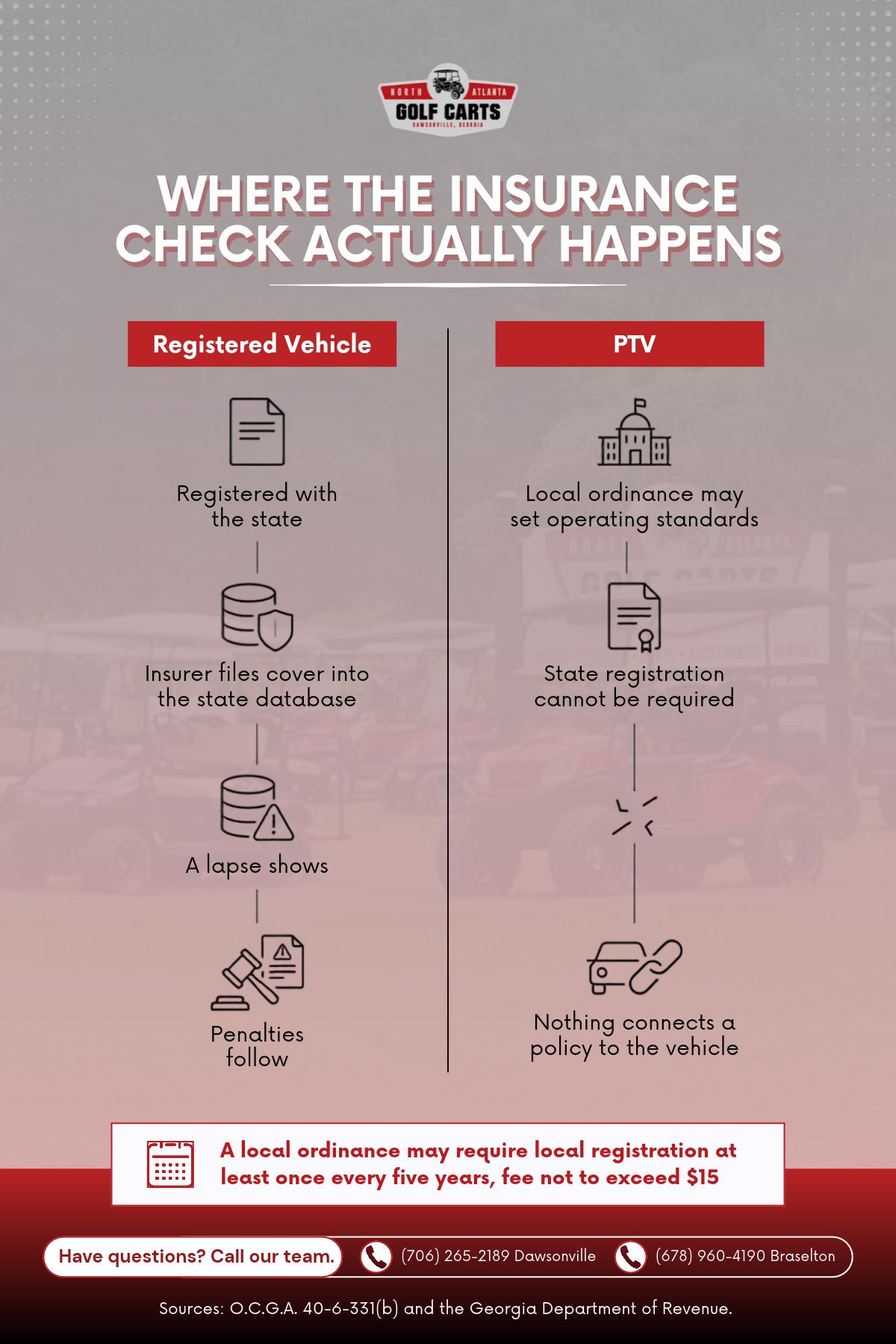
The part almost nobody knows: Georgia law says local ordinances may not require PTVs to meet the general-law requirements for registration, inspection, certificate of title, or licensing. Georgia enforces insurance through vehicle registration, with insurers reporting coverage electronically into the state’s motor vehicle database. Put those two facts together, and a PTV sits outside the machinery that would otherwise notice you had no coverage, which is why nothing ever flags it.
This page explains the legal categories. It is not insurance advice, and it cannot tell you what your policy covers. Only your insurer can do that.
The Three Categories, in the State’s Own Words
Get this wrong, and every other answer is wrong, because the categories are not interchangeable and the differences are precise.
| Category | How Georgia defines it |
| Golf car or golf cart | A motorised vehicle designed for the purpose and exclusive use of conveying persons and equipment to play golf, in an area designated as a golf course, with an average speed under 15 mph |
| Personal transportation vehicle (PTV) | A motor vehicle with a minimum of four wheels, a maximum level ground speed of less than 20 mph, a maximum gross unladen weight of 1,375 pounds, and capable of transporting not more than eight persons |
| Low-speed vehicle (LSV) | A four-wheeled electric vehicle whose top speed attainable in one mile is greater than 20 mph but not greater than 25 mph on a paved level surface, manufactured in compliance with the federal motor vehicle safety standards for low-speed vehicles in 49 C.F.R. 571.500 |
Those definitions are published by the Georgia Department of Public Safety.
The PTV definition has a second limb worth knowing. It also covers any motor vehicle with no fewer than three wheels and an unladen weight of 1,300 pounds or less that cannot operate above 20 mph, where the vehicle was authorised to operate on local roads by a local authority before 1 January 2012. Those are the vehicles some local ordinances still call motorised carts.
Speed is the line that moves you between categories
The single number that changes your legal position is top speed. Under 20 mph and you are looking at PTV territory. Above 20 but not above 25, built to the federal standard, and you are an LSV.
That matters because an upgrade can move you across the line without anyone filing anything. A controller change or a motor swap that lifts a cart past 20 mph has not just made it faster; it may have changed what it is. If you are considering custom upgrades, that is a conversation worth having before the work rather than after.
The Exemption Nobody Mentions
Here is the provision that explains why this whole subject is so murky.
Georgia’s PTV statute states that local authority ordinances may establish operating standards but shall not require PTVs to meet any requirements of general law as to registration, inspection, certificate of title, or licensing. It allows one narrow exception: a local authority may by ordinance require local registration and licensing of PTVs within its boundaries at least once every five years, for a fee not to exceed fifteen dollars. The section is O.C.G.A. 40-6-331.
The same section addresses drivers. All PTV operators must hold a valid driver’s licence, except when operating within a locality whose local authority enacted an ordinance permitting PTV or motorised cart use on streets without a licence before 1 January 2012.
So a PTV is deliberately held outside the state’s general vehicle registration and titling system. That is by design, and it is convenient. It also has a consequence that the statute does not spell out.
Why Nothing Ever Flags an Uninsured Cart
Georgia’s insurance enforcement runs through registration, and that is the connection people miss.
The Georgia Department of Revenue states that failure to maintain insurance coverage results in penalties including fines and possible suspension of the vehicle registration. It also explains that your insurance information must be sent electronically by your insurance company into Georgia’s motor vehicle database, and that if a vehicle is inoperable or out of service, you should cancel the registration before cancelling insurance to avoid fines. The details are on the department’s vehicle insurance requirements page.
Read that against the PTV exemption. The enforcement mechanism is: registration exists, insurer reports cover, state notices a gap, and registration gets suspended. A vehicle with no state registration has no place in that loop. There is no record for an insurer to report against and no registration to suspend.
That is not a loophole to enjoy. It means the absence of a warning letter tells you nothing at all about whether you are covered, and most owners are reading that silence as reassurance.
An LSV is in a different position, being a four-wheeled vehicle built to the federal standard and treated as a motor vehicle on the road. If your cart is an LSV, the ordinary motor vehicle expectations are the starting point rather than the exception.
Where People Assume the Cover Sits
Almost everyone we speak to assumes one of three things, and each is worth checking rather than assuming.
The first assumption is that the homeowner policy covers it. Homeowner policies commonly address property and liability at a residence and commonly contain motor vehicle exclusions, and where the line falls for a cart used on public streets is a question of the specific wording of the specific policy. We are a dealership, not an insurer, and we are not going to tell you what your policy says.
The second assumption is that the auto policy covers it, because the cart lives at the same address as the car. A personal auto policy is written around listed vehicles, and a cart that is not on it is not obviously on it.
The third assumption is that because nothing is required, nothing is at risk. That is the one this page exists to correct.
Liability does not depend on whether a registration exists. If a cart is involved in an incident that injures someone, the question of who pays is decided by ordinary legal principles and by whatever cover happens to exist, not by whether the state required any.
The one question to actually ask
Call whoever writes your home and auto cover and ask it in these terms: *I own a vehicle that Georgia classifies as a personal vehicle, I drive it on neighbourhood streets under a local ordinance, and I want to know in writing whether liability for that use is covered under any policy I currently hold.*
Naming the category matters. Asking about “a golf cart” invites an answer about a vehicle used on a golf course, which under Georgia’s definitions is a different thing entirely.
What Changes When Someone Else Drives It
This is the version of the question that keeps people awake, and it is the one the statute speaks to most directly.
Georgia requires all PTV operators to hold a valid driver’s licence, with a single carve-out: operating within a locality whose local authority enacted an ordinance permitting PTV or motorised cart use on streets without a licence before 1 January 2012. That exception is narrow; it is tied to a specific date, and it belongs to the locality rather than to the driver.
The practical reading is that unless you know your locality has such an ordinance and know it predates 2012, the licence requirement applies. A fourteen-year-old taking the cart to a friend’s house two streets away is not covered by a general sense that carts are informal.
Three situations worth thinking through
The first is unlicensed household drivers. Teenagers are the common case, and the answer turns on the ordinance in your specific locality rather than on neighbourhood custom.
The second is guests. A visiting adult with a licence satisfies the licence point, which leaves the separate question of whether any policy you hold responds to a vehicle driven by someone who is not you. That is another question for the insurer rather than for us.
The third is lending it out. A cart that leaves your property with somebody else driving is the scenario where every assumption in this article gets tested at once, and it is worth resolving before it happens rather than afterwards.
None of those three has an answer we can give you. What they have in common is that the answer comes from a policy document and a local ordinance, both of which you can obtain in an afternoon, and neither of which anyone will send you unprompted.
What Changes If You Move to an LSV
Buyers often ask whether stepping up to an LSV is worth it, and the honest answer is that it changes the legal picture rather than simply making the vehicle faster.
An LSV is defined by capability and by compliance with the federal standard, so it arrives as a vehicle the road rules already recognise. That brings the ordinary obligations that come with a road vehicle, and it removes the ambiguity that sits around a PTV operating under a patchwork of local ordinances.
The federal standard referenced in the LSV definition is worth a moment, because it is doing real work. Georgia does not simply say an LSV is a fast cart. It says the vehicle must be manufactured in compliance with the federal motor vehicle safety standards for low-speed vehicles set out in 49 C.F.R. 571.500, as in effect on 1 January 2001.
That is a manufacturing standard, not a modification you can perform. A cart built as a PTV and then made faster has not become an LSV in the sense the definition uses, because the definition is about how the vehicle was manufactured and to what standard. This is the distinction that catches people who assume a speed upgrade promotes their cart into a more permissive category.
Whether that trade is worth making depends on where you actually drive. Someone whose entire use is inside one neighbourhood with a permissive ordinance has a different calculation from someone crossing roads between two subdivisions. Our guide to Georgia’s golf cart laws covers where each category may be driven, and the Peachtree City guide covers the best-known local example of a cart-friendly ordinance.
Before You Buy, and Before You Sell
Two moments where this becomes practical rather than theoretical.
Buying used is the first. The category a cart falls into depends on what it can now do, not on what it was sold as when new, so a modified cart may not be the thing the previous owner believed they owned. That is one more item for the used cart inspection checklist, alongside the mechanical checks.
Financing is the second. A lender with an interest in a vehicle will generally have expectations about coverage, and those expectations are contractual rather than statutory, which means they apply regardless of what the state does or does not require. Our notes on leasing against financing cover the wider decision, and what a car costs covers the purchase side.
Ask the Insurance Question Before the Next Ride
The categories are public, the exemption is in the statute, and the enforcement gap follows from both. What none of that tells you is what your own policy says, and that is a five-minute phone call you can make today. Come and talk to North Atlanta Golf Carts about which category a cart actually falls into, because that is the part we can answer, and it is the part the insurer will ask you first.