
For most North Atlanta metro buyers, pick Club Car if you want the smoothest ride and the strongest resale on an aluminum frame, E-Z-GO if you want the widest lithium and accessory options at a lower entry price, and Yamaha if quiet running and a proven gas option matter most. We sell and service all three at our Dawsonville shop, so the honest answer depends on your terrain, whether you want lithium or gas, and how street legal you need the cart to be. Below we match each brand to real Georgia use so you buy once, not twice.
Here’s What Most First-Time Buyers Get Wrong
Plenty of shoppers walk in convinced one brand is simply “the best,” then leave with a different cart once we talk through where they actually drive it. A cart that feels perfect flat on a showroom floor behaves differently on a Cumming subdivision hill or a gravel driveway in Braselton. The three golf cart brands we stock most heavily, Club Car, E-Z-GO, and Yamaha, each win for a different buyer, and the deciding factor is rarely the badge on the front.
What follows is a head-to-head on the things that change your day-to-day: hills and neighborhood terrain, lithium versus lead-acid versus gas, ride comfort, how street legal you can make it in Georgia, and parts and service you can actually get locally. We also share the one lithium detail we wish every buyer knew before they picked a brand.
Matching Golf Cart Brands to How You Actually Drive in North Georgia
The Atlanta metro is not flat. Subdivisions around Suwanee, Johns Creek, and Alpharetta sit on real grades, and a cart that struggles up your street loses its charm fast. This is where the brand choice starts to matter more than spec sheets suggest.
Here is the short version of how we steer buyers; then we get into each brand.
| If your priority is | We usually point you to | Why |
| Smoothest ride and best resale | Club Car | Aluminum frame, independent-feel ride, holds value |
| Most lithium and accessory choices | E-Z-GO | Huge aftermarket, strong lithium lineup, lower entry price |
| Quiet running or a gas option | Yamaha | QuieTech EFI gas engine, quiet electric, comfortable seating |
| Street legal neighborhood use | Any of the three as an LSV | All can be built to Georgia low-speed-vehicle spec |
Numbers below are honest ranges based on what we see move off our lot, not fixed prices. New-cart pricing shifts with model year, options, and battery type, so treat these as planning figures and confirm current stock with us.
Hills and terrain: what the grade does to your choice
On flat cul-de-sacs, all three brands feel similar. On a real grade, the drivetrain and torque tuning separate them. E-Z-GO’s AC drive is known for snappy low-end pull, which neighborhood buyers with steep driveways tend to like. Club Car’s setup feels smooth and planted climbing, which matters if you are carrying passengers up a hill. Yamaha sits comfortably in the middle, and its gas models give you torque that never sags on a long climb, useful on larger rural properties toward Dawsonville and the north end of the metro.
If your street has a grade steeper than it looks, tell us. We would rather size the motor and battery to the hill than sell you a cart you have to baby uphill.
What terrain does to range and battery life
The other thing hills do is eat range. A cart rated for 25 to 30 miles on flat ground can lose a meaningful chunk of that if half your trips involve climbing back up to the house. This is where buyers get surprised: they judge range off the brochure number, then find the pack is drained faster than expected because every trip home is uphill. Lithium hides this better than lead-acid because it holds voltage under load, but the effect is real on any chemistry. We ask about your typical trip, to the mailbox, around the subdivision, down to a community dock or pool, and size the pack to the round trip including the climb, not just the flat mileage. On larger rural lots toward Dawsonville and the northern edge of the metro, where trips are longer and grades are steeper, this is often what decides between a gas Yamaha and a lithium electric cart.
Lithium, Lead-Acid, or Gas: The Choice That Outranks the Brand
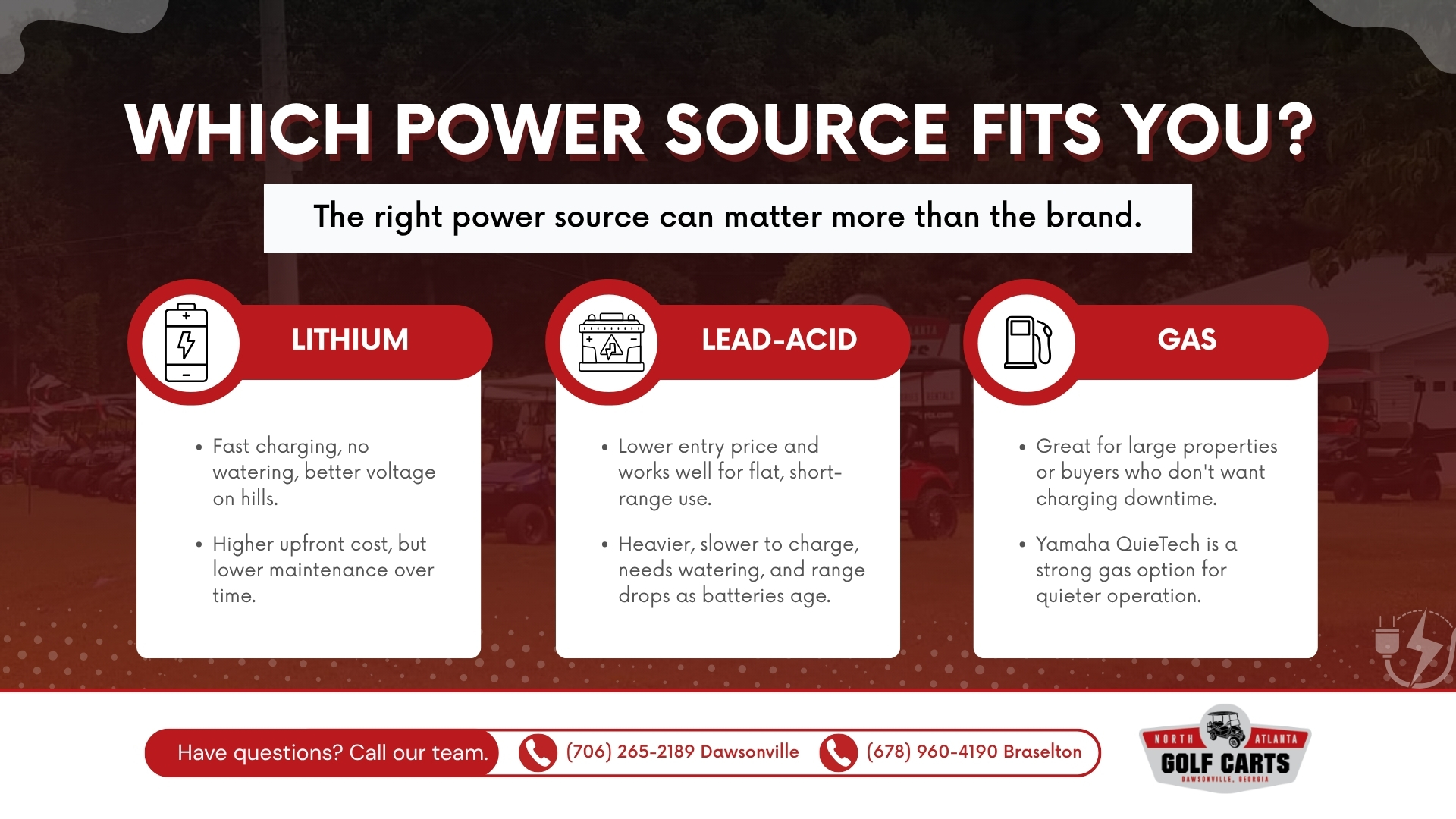
For a lot of buyers, the power source decision matters more than Club Car vs E-Z-GO vs Yamaha. Get this right and any of the three will serve you for years.
- Lithium is lighter, charges faster, needs no watering, and holds voltage better up hills. It costs more up front and pays back over years of lower maintenance. All three brands offer lithium, and we also do lithium conversions on existing carts.
- Lead-acid is the lower entry price and still fine for flat, short-range neighborhood use. The trade-off is weight, slower charging, watering the batteries, and shorter usable range as the pack ages.
- Gas makes sense on large properties or where you do not want to think about charging. Yamaha’s fuel-injected QuieTech engine is the quiet standout here, and it is the brand we reach for first when a buyer wants gas.
The lithium detail we wish every buyer knew
Here is the practitioner insight most comparison articles skip: not every lithium cart is built the same, and the battery management system (BMS) is what actually decides how the cart behaves on a hot North Georgia afternoon or a steep climb. A cheap drop-in lithium pack with a weak BMS can throttle power or shut off under load right when you need torque uphill, exactly the conditions our hilly subdivisions create. When we set up or convert a lithium cart, we match the BMS and pack to the terrain you described, which is something a spec sheet or a big-box listing will never tell you. Two carts with the “same” 48V lithium label can perform very differently, and that gap shows up on the first steep driveway, not in the showroom.
Ride, Comfort, and Fit: Club Car vs E-Z-GO vs Yamaha
Ride quality is where personal taste takes over, so we always suggest sitting in all three before you decide.
Club Car and Yamaha both ride smoothly from the factory, and buyers who prioritize a cushioned feel often land on one of those two. E-Z-GO’s newer independent-suspension models have closed much of that gap, and its base models feel a touch firmer, which some buyers actually prefer for a sportier feel. Seating comfort, legroom, and how easy it is to step in and out weigh heavier than buyers expect, especially for older drivers or families loading kids.
If you plan to carry four or more people regularly, look hard at the 4-passenger and 2+2 configurations across all three. We keep 4-seaters in stock because that is what neighborhood families around Buford and Suwanee ask for most.
Street Legal in Georgia: Turning Any of the Three Into an LSV
A common reason buyers upgrade is wanting to drive legally on low-speed neighborhood roads. In Georgia, a cart built to low-speed-vehicle (LSV) standards, with the required lighting, mirrors, seat belts, windshield, and a VIN, can be registered and driven on roads posted 35 mph or under. All three golf cart brands we stock can be built or upgraded to that spec.
This is worth deciding before you buy, because starting with a cart that is easy to bring up to LSV standard is cheaper than retrofitting later. If street-legal use is your goal, ask us about our street-legal golf carts for sale Atlanta buyers rely on, and we will scope the exact equipment your neighborhood needs.
Parts, Service, and Resale: The Long-Term Cost Nobody Compares
The purchase price is the smallest part of owning a cart. What it costs to keep running, and what it is worth when you sell, usually matters more over five to ten years.
| Factor | Club Car | E-Z-GO | Yamaha |
| Frame | Aluminum, resists corrosion | Steel, rugged and fleet-proven | Steel, durable |
| Resale value | Typically strongest | Solid | Solid, strong for gas models |
| Aftermarket parts | Wide | Widest, deep accessory ecosystem | Good |
| Gas option | Limited | Available | QuieTech EFI, class leader |
| Entry price (new, planning range) | Higher | Lower | Middle |
The frame point is real. Club Car’s aluminum frame shrugs off the corrosion that steel frames can develop, which matters in Georgia humidity and around irrigation and pool areas. E-Z-GO counters with the deepest aftermarket, so parts and upgrades are easy to source and often cheaper. Because we are a factory-authorized dealer for these brands and service them in-house, warranty work and repairs stay local instead of shipping your cart out of state.
If long-term value is your top concern, Club Car usually edges the group on resale, and we can show you what comparable used units are selling for when you are ready to trade up.
One more thing on service that rarely makes it into a comparison article: how easy the cart is to get serviced depends heavily on whether the shop touches that brand every day. We work on Club Car, E-Z-GO, and Yamaha constantly, so we stock the common wear parts, chargers, controllers, and solenoids for all three, and we can often turn a repair around without a special order. A brand we rarely see would mean waiting on parts. That day-to-day familiarity also means we spot the small stuff early: a solenoid that clicks, a charger that is slow to kick on, a lithium pack that is not balancing right, before it strands you at the top of your driveway. When you buy from a dealer who services the brand in-house, the whole ownership experience gets simpler, and that is worth as much as any spec on the sticker.
Trade-ins and buying used across the three brands
A lot of North Georgia buyers start with a used cart, then trade up once they know what they actually want. All three brands hold up well used if they were maintained, but the condition of the battery pack matters far more than the badge. A tired lead-acid pack can knock a used cart’s real value down fast, while a healthy lithium pack holds it. When you trade in or buy used with us, we test the pack, not just the cart, so you are paying for the range you will actually get. If you bought the wrong brand elsewhere and it does not fit your terrain, a trade-in is usually the cleanest fix.
So Which Brand Should You Actually Buy?
There is no single best cart, only the best cart for your terrain, power preference, and how you will use it. To make it concrete:
- Steep neighborhood, want a premium ride and top resale: Club Car, ideally lithium.
- Budget-minded, love customizing, want the most accessory options: E-Z-GO.
- Want gas, or the quietest running cart for a larger property: Yamaha.
- Need it street-legal for neighborhood roads: any of the three built to Georgia LSV specs.
Come sit in all three at our Dawsonville showroom and drive them on a real grade before you commit. That fifteen-minute test does more than any spec chart. You can also browse our full range of golf carts for sale Atlanta shoppers come to us for across the metro.
Where to go from here
The fastest way to get this right is to tell us where you drive, whether you want lithium or gas, and if you need the cart street legal, then let us match you to the brand that fits. We stock a deep inventory of Club Car, E-Z-GO, and Yamaha; we service and upgrade all three in-house, and we have done so for North Georgia families since 1997. When you are ready to compare in person, North Atlanta Golf Carts will walk you through the real trade-offs and get you on the cart that suits your street, not just the one with the flashiest brochure.