
If you’ve been around golf carts for a while, you know the routine. Lead-acid batteries need to be topped off with distilled water. Corrosion on the terminals. The slow loss of range as the pack ages. The dread of pulling old heavy batteries out of a cart and lugging them to a recycling center. Charging that takes most of a day. The whole process is something cart owners have just put up with for decades because there wasn’t a better option. Now there is.
Lithium batteries have been on the market for a while, and they’ve gotten cheap enough, reliable enough, and easy enough to install that the question isn’t really “should I upgrade?” anymore. It’s “When should I upgrade?” “And if you’re asking that, the honest answer is that this spring is probably the best time to upgrade to a lithium golf cart battery you’ll get for a while.
We replace lead-acid packs with lithium across north Georgia all the time, and the difference for owners is dramatic. Better range, lighter cart, faster charging, less maintenance, longer lifespan. Here’s the full story on why lithium is worth the switch and what you should know before you make the move.
The Lead-Acid Reality
Most older carts still run on lead-acid batteries because they were the standard for decades. Lead-acid does work, but it has a long list of downsides that lithium fixes:
- Heavyweight (often 60+ pounds per battery, with 6 batteries common in a cart)
- Short usable lifespan (3 to 5 years for daily use)
- Slow charging (8 to 10 hours for a full charge)
- Performance drops as the battery discharges
- Range loss as the pack ages
- Acid leaks and corrosion damage
- Regular maintenance required (water levels, terminal cleaning)
- Capacity drops in cold weather
- Lower depth of discharge (you can’t use the full capacity without damage)
- Heavy environmental impact when disposed of
If you’re running daily, you’ve probably dealt with most of these. They’re the reality of lead-acid ownership. None of them is catastrophic on their own, but together they add up to a meaningful drag on the experience and the long-term cost.
What Lithium Does Differently
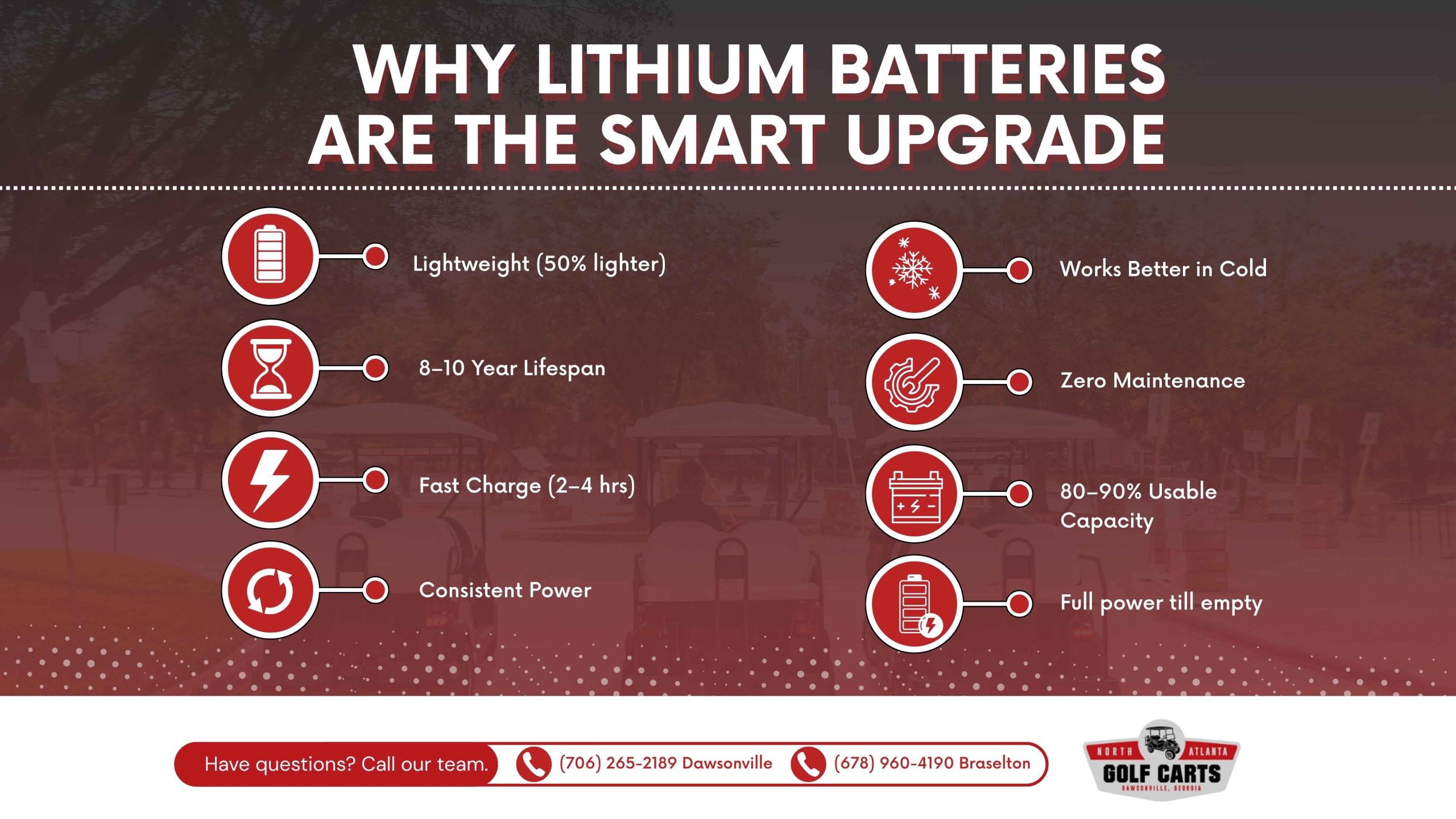
Lithium batteries flip almost every one of those issues:
- Lightweight (often half the weight of equivalent lead-acid)
- Long lifespan (8 to 10 years or more for typical use)
- Fast charging (2 to 4 hours for a full charge)
- Consistent power across the full discharge cycle
- Maintains range as the pack ages (much smaller capacity loss)
- Sealed, no acid, no leaks
- No water topping off, no terminal cleaning
- Better cold-weather performance
- High depth of discharge (you can use 80 to 90 percent of capacity)
- Smaller environmental footprint over the life of the battery
The headline differences for most cart owners are the longer life, the lighter weight, and the consistent performance. Once you ride a lithium cart, going back to lead-acid feels obviously slower and weaker.
Why Spring Is the Right Time
A few practical reasons make spring the best window for a lithium upgrade:
You’ll use it all season: Spring marks the start of cart season for most owners. Upgrading now means you get the benefits for the busiest months of the year, instead of doing it in the fall and only getting partial use before winter.
Battery prices have come down: Lithium prices have dropped meaningfully over the past few years as the technology matured and demand grew. The dollar-per-feature ratio has never been better.
Lead-acid is at its weakest after winter: If your old pack survived another cold season, it’s probably running on borrowed time. Many lead-acid packs that limped through winter fail in early summer when they suddenly get heavy use.
Service availability: Cart shops are less booked in spring than in summer, so you can typically get the install done quickly.
Comparison opportunity: Spring is when you start riding more, so you’ll immediately notice the performance difference. The contrast is much more obvious in the first month after the upgrade than it would be if you switched in winter.
The Range Difference
This is the one that surprises people the most. Lithium carts simply go further on a charge than lead-acid carts of the same nominal capacity.
The reasons:
- Lithium delivers consistent voltage from start to finish, so the cart maintains its full power output until almost empty
- Lithium has a higher energy density per pound, so you carry more power without carrying more weight
- The lighter overall cart weight means less energy is needed to move it
- Lithium can use 80 to 90 percent of its capacity without damage, vs about 50 percent for lead-acid
The combined effect is that a lithium cart often goes nearly twice as far as the same cart with a comparable lead-acid pack. For owners who use carts for longer rides, errands around town, or daily commuting in cart-friendly communities, that range difference completely changes how the cart fits into daily life.
Charging Time Matters More Than You’d Think
Lead-acid car batteries typically take 8 to 10 hours to fully charge. That sounds fine until you actually live with it. You ride in the morning; the cart needs the rest of the day to charge, you can’t ride again until evening or the next morning. Or you ride in the evening, the cart charges overnight, and you’re tied to the morning starting routine.
Lithium charges in 2 to 4 hours for most cart pack sizes. That means you can ride in the morning, charge over lunch, and ride again in the afternoon. The cart becomes much more flexible. Spontaneous trips happen instead of getting put off because the battery isn’t ready.
For owners who use their cart for daily transportation in coastal or community settings, this is a quality-of-life upgrade as much as a performance upgrade.
The Maintenance Difference
Lead-acid batteries need real attention:
- Check water levels every 1 to 2 months
- Top off with distilled water
- Clean terminal corrosion with baking soda paste
- Apply protective coating to terminals
- Test specific gravity periodically
- Ensure proper ventilation in the battery box
- Replace damaged cables and connections
- Monitor for sulfation and uneven cell wear
Lithium batteries are essentially set-and-forget. The battery management system handles cell balancing, temperature monitoring, and overcharge protection internally. There’s no water to check, no acid to worry about, no corrosion to clean. You plug it in to charge, you ride, and you plug it in again. That’s the maintenance routine.
The time savings alone are meaningful. The peace of mind is bigger.
What Lithium Costs
The upfront cost is the main reason some owners hesitate. Here’s what you can expect for a typical residential cart upgrade in North Georgia:
- Basic lithium kit (smaller pack, basic features): $1,500 to $2,500
- Mid-range lithium kit (good capacity, standard features): $2,500 to $4,000
- Premium lithium kit (high capacity, advanced BMS, longer warranty): $4,000 to $6,000+
These are pack costs. Installation by a qualified shop typically adds $200 to $500, depending on the cart model and any wiring or controller adjustments needed.
Compared to lead-acid replacement, which usually costs $700 to $1,500 for a full set of batteries. Lithium is roughly 2 to 4 times more expensive upfront. But lithium lasts 2 to 3 times longer, performs better the whole time, and saves you maintenance costs along the way. Over the full lifecycle, lithium is usually the cheaper option per year of use.
What Cart Owners Should Know Before Upgrading
If you’re seriously considering the switch, run through these questions:
- Is your cart’s electrical system compatible with lithium voltages?
- Does your charger work with lithium, or do you need a new one?
- Does your motor controller need any adjustments?
- Is the battery box the right size for the new pack?
- Are there any wiring changes needed for the new BMS?
- What’s the warranty on the lithium pack?
- Who handles service if something goes wrong?
- Is the installer experienced with lithium upgrades?
A qualified cart shop can answer all of these and handle the installation correctly. Don’t try to mix random lithium components with old hardware. The savings aren’t worth the risk of damage.
Long-Term Cost Math
Here’s a simplified comparison for a typical cart owner over 10 years:
Lead-acid scenario:
- Initial pack: $1,200
- Replacement pack at year 4: $1,300
- Replacement pack at year 8: $1,400
- Maintenance and water/cleaning: $200
- Total over 10 years: $4,100
- Performance: declining range, slower charging, regular maintenance
Lithium scenario:
- Initial pack: $3,500
- One pack lasts the full 10 years
- Maintenance: minimal
- Total over 10 years: $3,500
- Performance: consistent throughout, fast charging, no maintenance
Lithium often comes out cheaper over a full lifespan, plus you get a better experience the whole time. The math gets even more favorable for owners who use carts heavily.
Wrapping Up
Lithium isn’t a luxury upgrade anymore. It’s the smarter long-term choice for almost any cart owner who plans to use the cart regularly for the next several years. Better performance, longer life, faster charging, and less maintenance combine to make it the obvious move once you actually compare the experience. Spring is the best time to make the switch because you’ll get the full season of benefits and avoid the lead-acid weak point that often shows up in early summer.
When you’re ready to talk about an upgrade, we’re happy to look at your cart, recommend the right pack, and handle the install correctly. At North Atlanta Golf Carts, we work with cart owners across the region every week, and we’ll always give you a straight answer on what makes sense for your specific cart and how you use it. Give us a call when you’re ready, and we’ll take it from there.