
A utility golf cart has two load numbers, and the smaller-looking one is the one that limits you. Club Car rates its Carryall 502 bed at 800 lb and the whole vehicle at 1,200 lb, and that 1,200 includes the people on the seat. Two adults and a full bed can put you over the rating before you pull out of the barn in Dawsonville.
TL;DR
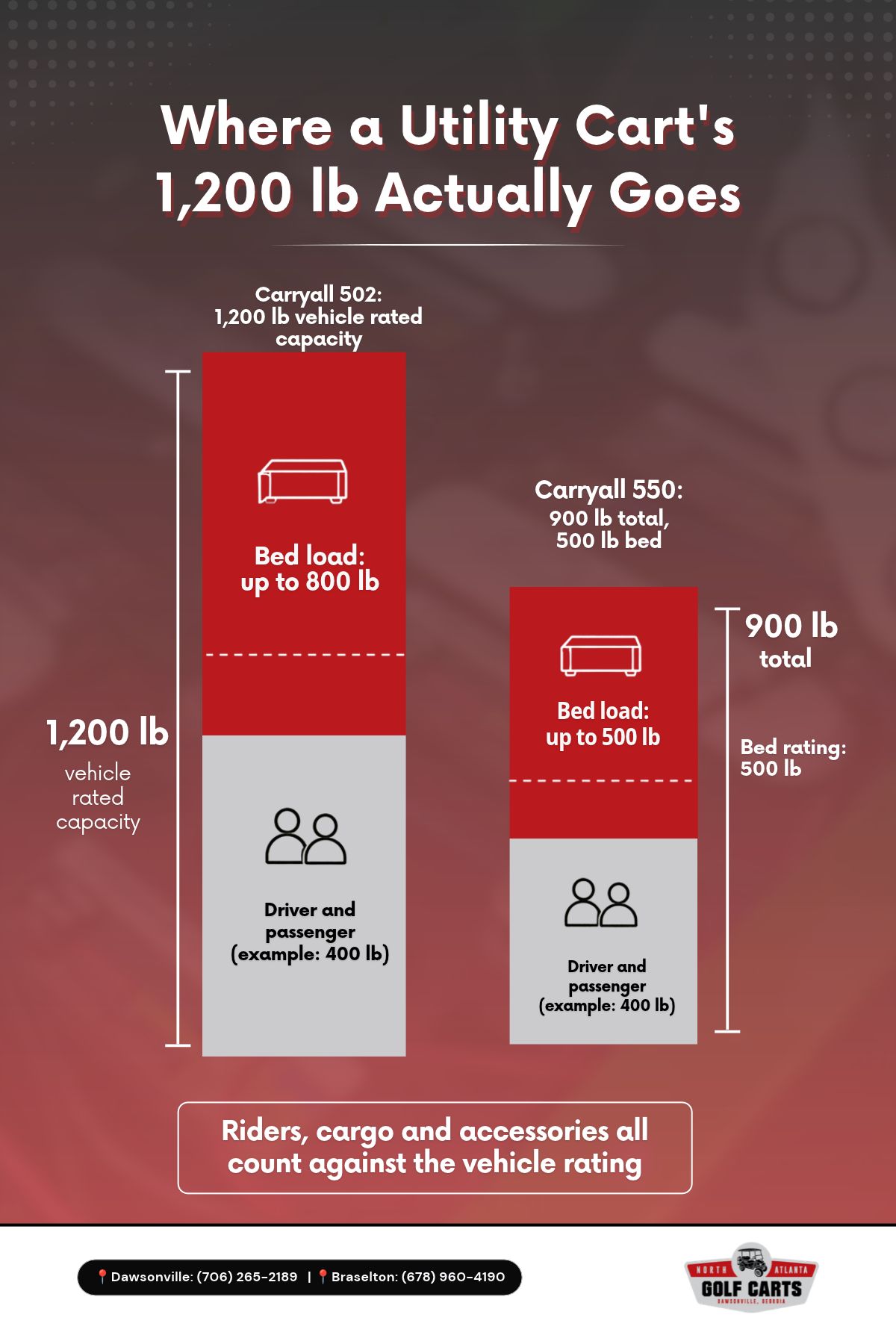
A utility golf cart carries a bed rating and a separate vehicle-rated capacity, and the vehicle figure covers riders, cargo, and accessories together. On the Club Car Carryall 502, the bed is rated at 800 lb and the vehicle at 1,200 lb, so a driver and passenger weighing 400 lb between them leave 800 lb for the bed, and anything heavier on the seat eats into the bed. The electric Carryall 550 is rated lower again, at 900 lb total and 500 lb in the bed. Curb weight matters in Georgia too: the state defines a personal transportation vehicle with a maximum gross unladen weight of 1,375 lb, and Club Car’s 2020 spec sheet lists the lead-acid electric 502 at 1,393 lb. Small farms dominate Dawson, Hall, and Forsyth counties, which is why this math comes up so often at our counter.
What Is a Utility Golf Cart, Exactly?
A utility golf cart is a golf-cart-sized vehicle built around a cargo bed instead of a rear seat, rated to carry a stated load and usually to tow. Club Car’s Carryall line is the plainest example. The Carryall 502 has a 44.2 x 47.5 x 10.5 inch cargo box, drum brakes on all four wheels, and a hitch rating of 1,500 lb.
The name confuses people because it covers two different things on a dealer lot:
| What buyers call it | What it usually is | Built for |
|---|---|---|
| Utility golf cart (factory) | A purpose-built utility vehicle such as a Carryall, with a load-rated bed and a published towing figure | Hauling feed, mulch, tools, firewood |
| Utility golf cart (converted) | A passenger cart with a flip seat or a cargo box bolted where the rear seat was | Light loads, mostly people |
| UTV or side-by-side | A larger off-road machine with more ground clearance and often four-wheel drive | Rough trails, steep grades, heavy work |
The first row is what this page is about. A flip seat on a passenger cart turns into a small platform, and nothing on it carries a manufacturer’s bed rating the way a Carryall does.
Why Is the Bed Rating Not the Whole Story?
The bed rating tells you what the box can hold; the vehicle rated capacity tells you what the whole machine can carry, riders included. On the Carryall 502, those figures are 800 lb and 1,200 lb in Club Car’s Carryall 502 specification sheet. The gap between them is the allowance for people and anything else on board.
So the working number is never 800. It is 1,200, less whoever is sitting down, less any accessories, and the bed takes what is left up to its own 800 lb cap.
The seat is part of the load
Run it with your own numbers. We do this on paper with most buyers who tell us they plan to haul.
- Start with the vehicle rated capacity: 1,200 lb on a Carryall 502.
- Subtract the driver and any passengers, at what they actually weigh.
- Subtract bolt-on weight: a windshield, a roof rack, a toolbox, a sprayer tank sitting empty.
- What is left is your real bed allowance, capped at the 800 lb bed rating.
Two riders at 200 lb each leave exactly 800 lb, which matches the bed rating and leaves nothing for a toolbox. Two riders at 230 lb each leave 740 lb. The bed never had a problem; the seat did.
Towing adds its own figure
The same sheet lists a towing capacity of 1,500 lb and a combined gross vehicle capacity of 1,500 lb for the 502. Read those as separate ceilings. A trailer full of split oak behind a cart that is already full is the situation the combined figure exists to stop.
Here is how the arithmetic plays out on a firewood run. A driver with 200 lb and 300 lb of wood in the bed uses 500 of the 1,200 lb vehicle rating. Hitch a trailer, and the 1,500 lb combined figure becomes the one to watch. It is far smaller than the vehicle rating, and the towing figure is added together, so we read it as one ceiling the loaded cart and the trailer share. Split the load between trips before you split the difference with the spec sheet.
How the Carryall Models Compare on Paper
Club Car publishes the lithium line side by side in its Carryall Lithium brochure, and the differences are bigger than the model numbers suggest.
| Carryall Lithium model | Vehicle rated capacity | Cargo bed capacity | Curb weight | Ground clearance | Bed length |
|---|---|---|---|---|---|
| 500 | 1,200 lb | 800 lb | 951 lb | 5.6 in | 44.2 in |
| 502 | 1,200 lb | 800 lb | 938 lb | 4.2 in | 44.2 in |
| 550 | 900 lb | 500 lb | 1,020 lb | 6.0 in | 44.2 in |
| 700 | 1,500 lb | 1,000 lb | 1,013 lb | 5.6 in | 64.5 in |
The 550 surprises people. It rides on 22 x 10-10 extra-traction tires with the most clearance in the family, and it carries the least. That trade makes sense on soft pasture and makes no sense for hauling 40 bags of pellets.
The 700 is the other end. Its 99.1-inch wheelbase and 64.5-inch bed make it the one to look at if the job is long material rather than heavy material, like fence rails or lumber.
All four share a 5 to 19 mph speed range in the lithium brochure, with a 19 mph top setting that Club Car describes as new for the line.
The Weight Number That Matters on a Georgia Road
Curb weight is a spec most buyers skip, and in Georgia it can decide how the state classifies the cart. The Georgia Department of Public Safety publishes the code definition of a personal vehicle: at least four wheels, a maximum level ground speed under 20 mph, a maximum gross unladen weight of 1,375 lb, and room for no more than eight people.
Now line that up against the spec sheets:
| Carryall 502 version | Curb weight (with batteries) | Top speed on the sheet | Against the 1,375 lb PTV ceiling |
|---|---|---|---|
| Gas, Kohler EFI (2020 sheet) | 907 lb | 15 to 17 mph | Under by 468 lb |
| Electric, eight 6-volt flooded lead-acid (2020 sheet) | 1,393 lb | 5 to 17 mph | Over by 18 lb |
| Electric, lithium (2023 brochure) | 938 lb | 5 to 19 mph | Under by 437 lb |
That middle row is worth a pause. Curb weight and gross unladen weight are close relatives, but they are not guaranteed to be measured the same way, so treat the 18 lb as a flag rather than a ruling. If a lead-acid Carryall is going to be driven on a street your city or county has opened to carts, ask the local authority how it reads the definition before you rely on it.
The lithium version sidesteps the question by a wide margin. Across the two Club Car documents, moving the 502 from flooded lead-acid to lithium takes 455 lb off the curb weight. Every accessory bolted on afterward adds unladen weight back, so a lead-acid cart that already sits at the line has no room for a windshield, a roof, and a rack.
That is a weight argument for lithium you will not see in most battery comparisons, which tend to talk about maintenance and charging; our lithium against lead-acid cost breakdown covers that side.
Which roads a utility cart can use at all
Georgia leaves street use to local government. The same DPS page explains that local governing bodies may designate certain public streets for combined use by carts and regular traffic, which means the answer changes when you cross a city or county line. We keep the details on Georgia’s golf cart rules, and anyone who needs a vehicle that is road-registered rather than street-permitted should read our low-speed vehicle page before buying a utility cart for the job.
Who in North Georgia Actually Needs One?
People with land and chores, mostly, and our part of Georgia has a lot of small land. The USDA’s 2022 Census of Agriculture county profile for Dawson County counts 170 farms averaging 93 acres, and 74 of them, 44 percent, fall between 10 and 49 acres.
The neighboring counties look similar in the same census:
| County (seat) | Farms, 2022 | Average farm size | Farms of 10 to 49 acres |
|---|---|---|---|
| Dawson (Dawsonville) | 170 | 93 acres | 74 |
| Hall (Gainesville) | 574 | 76 acres | 297 |
| Forsyth (Cumming) | 262 | 60 acres | 145 |
That is hobby-farm and horse-property country, not row-crop country. Livestock, poultry, and their products made up 100 percent of Dawson County’s farm sales in 2022, and woodland was the largest single use of its farm acreage at 6,429 acres. Feed, bedding, fence repair, and downed limbs are the loads we hear about, and none of them are light.
The jobs, sorted by which number they test
| Job | Which rating it tests first |
|---|---|
| Hay, feed and bagged bedding | The 800 lb bed rating, because the load is dense |
| Firewood and brush | The vehicle rating, once a second person rides along |
| Fence rails and lumber | Bed length rather than capacity, which points at the 700 |
| Tools, a sprayer, a chainsaw | The vehicle rating, because they live on the cart every trip |
| Pulling a small trailer | The towing and combined figures, not the bed |
The campgrounds and event venues we sell to around Buford and Lake Lanier load the same carts differently: coolers, chairs, and sound gear, usually with a full seat up front.
Gas, Lead Acid or Lithium for Hauling
Pick the powertrain by the land and the load, then check it against the numbers above. Our broader gas against electric comparison covers everyday use; this is the hauling slice of it.
| Question | Gas Carryall 502 | Lead-acid electric 502 | Lithium 502 |
|---|---|---|---|
| Curb weight on Club Car’s sheet | 907 lb | 1,393 lb | 938 lb |
| Peak torque on the sheet | 19.91 ft-lb at 2,400 rpm | 71 ft-lb at 1,450 rpm | Not listed; 21.4 hp peak |
| Battery or fuel | 5.5 gal tank | Eight 6-volt flooded batteries | 7.0 kWh lithium standard |
| Battery warranty | Not applicable | 4-year limited | 5-year limited |
Club Car’s lithium brochure says the lithium Carryall charges up to 40 percent faster than lead-acid and adds power for hill climbing and towing. It does not publish a grade rating, and neither do the other sheets, so we will not quote one.
Flooded lead-acid also needs watering and terminal cleaning, which the lithium brochure lists as the chores its battery removes. On a cart that lives in a pole barn and gets used hard on Saturdays, that is the honest tiebreaker.
Questions to Ask Before You Buy One
Walk onto any lot with these, and the spec sheet does the rest.
- Ask for the vehicle rated capacity and the bed capacity. Get both in writing.
- Find the curb weight with batteries, and whether it runs on lead-acid or lithium.
- Add up the two people who will ride most often.
- Name the heaviest single load you will carry, and how often.
- Will it tow, and what does the trailer weigh loaded?
- Will it ever go on a public street, and has your city or county designated that street for carts?
- Who services it, and on which days?
The last one is practical. Our service department runs weekdays, so a cart that works weekends on a farm is best brought in during the week between jobs.
Bring Your Heaviest Utility Load to Either Store
Tell us the heaviest thing you plan to put in the bed and who will be sitting up front, and we will run the subtraction with you against the actual spec sheet of each cart on the lot. You can check the utility golf carts for sale in our current inventory first, then visit either store, in Dawsonville on Highway 53 or in Buford on Thompson Mill Road. Every utility cart conversation at North Atlanta Golf Carts starts with those same two numbers, because they decide which model fits before color or accessories ever come up.