
A golf cart lift kit does not make a cart faster by itself. The taller tires it makes room for do. On a cart rated at 19 mph on 18-inch tires, a 20-inch tire works out to about 21 mph, and Georgia’s definition of a personal transportation vehicle, the class most street carts in Cumming, Dawsonville and Canton fall under, stops below 20.
TL;DR
A lift raises the body so a taller tire fits. A taller tire covers more ground per turn, so a cart whose motor or engine is capped at the same speed now rolls faster. E-Z-GO’s own owner’s manual rates its RXV Freedom at 19 mph on 18 x 8.5-8 tires, and the arithmetic puts that cart near 21 mph on 20-inch tires and above 24 mph on 23-inch tires.
Georgia defines a personal transportation vehicle as capable of a level ground speed of less than 20 mph. Federal rules put anything between 20 and 25 mph in the low-speed vehicle class, which comes with a fixed equipment list and a manufacturer’s certification. A lifted cart that clocks 22 mph sits in neither box. Measure top speed after the build, before the cart goes near a public street.
Does a Golf Cart Lift Kit Make the Cart Faster?
No, the lift kit alone changes height, not speed. What changes speed is the tire that goes on afterward, and almost nobody lifts a cart to keep the factory tire. A taller tire travels farther in one turn, so if the drive side still turns at its old top rate, the cart goes faster down the road.
The lift is the excuse. The tire is the cause.
That is the whole mechanism, and it is simple enough to check with a calculator. A governor on a gas engine or a speed setting on an electric controller limits how fast the engine or motor turns. Neither one can see the tire. Swap an 18-inch tire for a 22-inch tire and the limiter keeps doing its job at the same revolutions, while every revolution now carries the cart about 22 percent farther.
Owners usually notice the change one of two ways. The speedometer reads wrong, because it was calibrated to the old tire, or the cart simply feels quicker on the flat stretch of road near home, the one with no hill to slow it, where a cart that used to settle at its rated speed now keeps pulling for another second or two before it levels off. Our own blog said as much in June, when we noted that a cart on big tires may read high on the speedometer. What it did not say is what that extra speed does to the cart’s legal class, and that is the question this article answers.
The Arithmetic of a Taller Tire
Golf cart tire sizes read diameter first. An 18 x 8.5-8 tire is roughly 18 inches tall, 8.5 inches wide, and mounted on an 8-inch wheel. So the speed change from a tire swap is the ratio of the new height to the old one, multiplied by the old top speed.
We used the factory numbers from the E-Z-GO RXV EX1 owner’s manual, dated August 2024. It lists the RXV Freedom at a level ground speed of 19 mph, plus or minus 0.5 mph, on 18 x 8.5-8 tires. The Valor, from the same manual, is also rated at 19 mph but leaves the factory on 20 x 8-10 tires.
| Tire height after the build | RXV Freedom (19 mph on 18 in) | Valor (19 mph on 20 in) |
|---|---|---|
| 18 in (Freedom factory) | 19.0 mph | not applicable |
| 19 in | 20.1 mph | not applicable |
| 20 in (Valor factory) | 21.1 mph | 19.0 mph |
| 22 in | 23.2 mph | 20.9 mph |
| 23 in | 24.3 mph | 21.9 mph |
Read the Freedom column slowly. Even a one-inch step up lands right on the 20 mph line, and the factory tolerance matters too: a Freedom that left the plant at 18.5 mph comes out near 20.6 mph on 20-inch tires, and one at 19.5 mph comes out near 21.7.
Why the table is an estimate, not a reading
The printed height on a tire sidewall is a nominal figure. Under the weight of a cart and two adults, the tire squats and its rolling height drops a little, and tread wear takes a little more off over time. Air pressure moves it as well.
So the table tells you which direction a build moves and roughly how far. It cannot tell you what your cart does on your street. Only a measured run can.
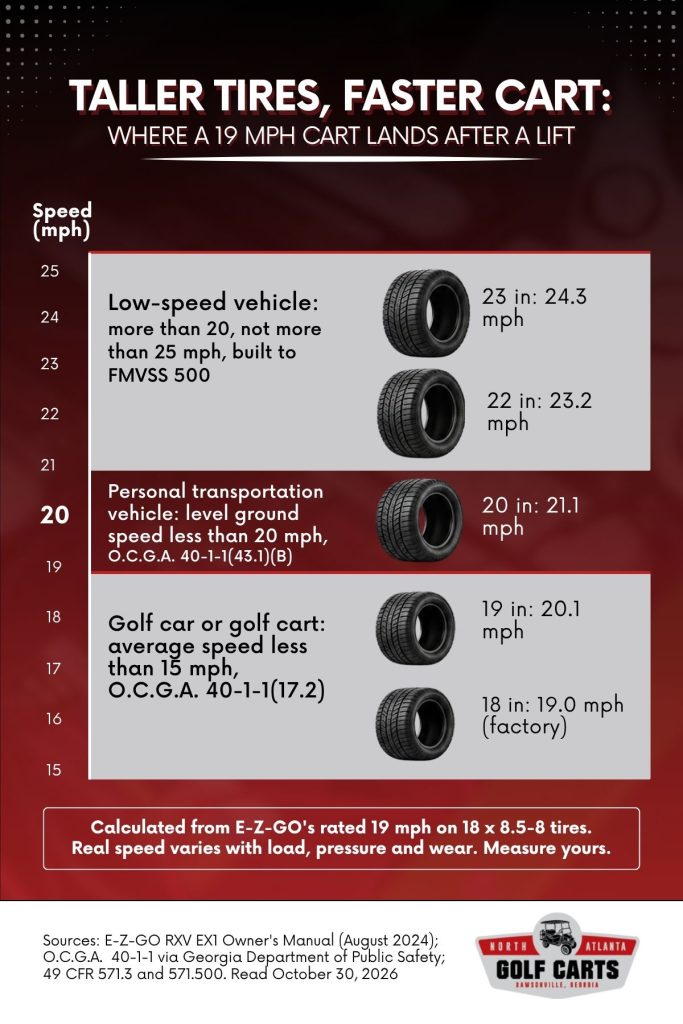
Three Speed Lines Georgia Draws Around a Cart
Georgia’s motor vehicle code sorts small carts by speed, and the cutoffs are written into the definitions in O.C.G.A. 40-1-1. The Georgia Department of Public Safety reprints the relevant ones on a single reference sheet, along with a pointer to 40-6-331, the section that lets a city or county open its own streets to carts by ordinance.
| Georgia class | Speed in the definition | Other limits in the definition |
|---|---|---|
| Golf car or golf cart, 40-1-1(17.2) | Average speed less than 15 mph on a level test course | Designed for use on a golf course |
| Personal transportation vehicle, 40-1-1(43.1)(B) | Maximum level ground speed less than 20 mph | At least four wheels, unladen weight up to 1,375 lb, eight people or fewer |
| Low-speed vehicle, 40-1-1(25.1) | Greater than 20 mph but not greater than 25 mph in one mile on a paved level surface | Four-wheeled electric vehicle built to the federal low-speed vehicle standard |
Most carts sold for neighborhood use around Alpharetta, Cumming and Gainesville already sit above the golf course line. The RXV Freedom at 19 mph is one of them, which is why the personal vehicle definition, and its ceiling of less than 20, is the one a lift actually threatens.
What sits between 20 and 25 when nobody certified it
Federal rule 49 CFR 571.3 defines a low-speed vehicle as four-wheeled, with a speed attainable in one mile of more than 20 mph and not more than 25 mph on a paved level surface, and a gross vehicle weight rating under 3,000 pounds. You can read that definition in the federal definitions list in 49 CFR 571.3.
Speed alone does not finish the job. Georgia’s own low-speed vehicle definition also requires the vehicle to be manufactured in compliance with the federal standard, 49 CFR 571.500. A lifted cart that now runs 22 mph has left the personal vehicle definition by speed, and it has not entered the other class by construction.
What Does E-Z-GO’s Manual Say About a Faster Cart?
E-Z-GO’s answer is blunt. The RXV EX1 manual tells owners never to alter the vehicle to increase travel speeds above factory specifications, and it says that a cart a dealer or a customer modifies to run at or above 20 mph on public streets becomes, under federal law, a low-speed vehicle.
The same page spells out what follows from that. Whoever does the modifying, the manual says, must fit the federal equipment, attach a vehicle identification number, and become the final vehicle manufacturer, responsible for titling or registering it as state law requires. The company also states that it will not approve changes that turn its carts into low-speed vehicles.
That is the maker, in its own manual, declining to sign off on the conversion.
Two more lines in the manual matter to anyone pricing a lift. The tire section reads: “Always use the size and type of tires specified for the vehicle.” And the modification section says the warranty ends if the cart is modified to increase its speed or power.
Other makers write their own manuals, and we are not quoting them here. If your cart is a Club Car or a STAR EV, read the safety and modification pages of its own manual before the build. The question to answer is identical: what does this maker say about a speed increase, and about tire sizes outside the specification?
How to Measure a Lifted Cart’s Top Speed
The legal definitions describe speed on level ground, and the federal test in 49 CFR 571.500 is run over one mile on a level paved surface with the cart’s unloaded weight plus 170 pounds for the driver and instruments. A home check cannot copy a lab. It can get close enough to tell 19 from 22.
- Find a flat, paved stretch on private property, long enough to reach full speed and hold it. A driveway up a Dawsonville hillside does not count.
- Charge an electric cart fully, or fill a gas cart’s tank, so the run reflects the cart at its best.
- Ride alone, or with one passenger close to the 170-pound test figure, and set tire pressure to the number in the owner’s manual.
- Use a GPS speed reading on a phone, not the cart’s speedometer, which is still calibrated to the old tire.
- Hold full speed for several seconds in both directions and write down the higher figure.
Keep that number with the cart’s papers.
If the number reads 20 or above, you have your answer before any argument about rolling height. If it reads 19.6, run it again on a cooler day with fresh tires and see if it holds, because tolerance works in both directions.
Four Ways to Keep a Lifted Build on the Right Side of 20
A lift and a street cart can live together. It takes deciding, before the parts are ordered, which of these the build is.
- Keep the tire height close enough to factory that the measured top speed stays below 20. You get some clearance, though not the tallest tires.
- Have the speed adjusted by the right people. The RXV manual says only its authorized dealers should alter a cart, using approved parts, so ask the shop what the maker allows on your model and how the build’s top speed will be kept under 20.
- Keep it a private-land cart. On a farm in Dawson County or a large wooded lot outside Canton that never meets a public street, the street classes stop mattering, though the manual’s tire and warranty language still applies.
- Buy a cart certified from the factory for the faster class, with the full federal equipment list already on board.
The fourth deserves a closer look.
The gap between a dressed-up cart and a certified one is wider than most buyers expect, and it is mostly paperwork and parts you cannot bolt on.
What Separates a Fast Cart From a Certified One?
Twelve required items, plus a manufacturer who signs for them.
The federal standard, FMVSS 500 in 49 CFR 571.500, caps the class at 25 mph and lists the equipment every one must carry.
| Required by FMVSS 500 | Commonly on a street-equipped cart already? |
|---|---|
| Headlamps, taillamps, stop lamps | Often, as an upgrade |
| Front and rear turn signal lamps | Sometimes |
| Red reflex reflectors on each side at the rear and one on the rear | Often |
| Driver’s side exterior mirror, plus a passenger side or interior mirror | Often |
| Parking brake | Yes |
| Windshield meeting the federal glazing standard, 49 CFR 571.205 | Not always; many car windshields are not rated |
| Seat belt assembly at every designated seating position | Rarely at every seat |
| A 17-character vehicle identification number under Part 565 | No, a cart carries a serial number |
| Rear visibility under FMVSS 111 S6.2 | Rarely |
| An alert sound under 49 CFR 571.141 | Rarely |
Lights and mirrors can be bolted on. A VIN, a rated windshield, a rear visibility system, and the certification behind them are a manufacturing job, which is the point E-Z-GO’s manual makes when it names the modifier as the final vehicle manufacturer.
We carry carts built and certified for the 20 to 25 mph class from Club Car and Denago, for buyers who want that speed on the road from day one.
Where a Lift Earns Its Keep Around Cumming and Canton
Ground clearance has real uses in this part of Georgia. Gravel drives, creek crossings on rural lots, and the uneven ground between a house and a dock on Lake Lanier near Cumming or Gainesville all reward a taller cart and a tire with real tread. That is why lift kits, all-terrain tires, and the rest of the upgrade list we stock and install for North Georgia riders keep coming up at the counter.
Street use is a different job. A family in an Alpharetta neighborhood or a Cumming subdivision that rides to the pool and back gains little from six inches of height and stands to lose the class its cart was built for. Which streets a cart may use at all is set city by city under 40-6-331, and the equipment each class needs before it rolls onto an approved North Georgia street differs between the classes too.
Sorting the build by where the cart lives
| Where the cart spends its time | Lift and tire priority | Speed check needed? |
|---|---|---|
| Private acreage, no public street | Height and tread first | Only for your own safety |
| Neighborhood streets a city has opened to carts | Factory-close tire height | Yes, after every tire change |
| Both, on the same cart | Pick the street rules, then fit the tallest tire that still measures under 20 | Yes, and keep the result |
Questions to Settle Before a Lift Goes on the Work Order
Ask these out loud, at whatever shop does the install, and get the answers in writing. They are short, and every one of them comes straight from the documents above.
- What tire height is this build going to, and what does the arithmetic say the top speed becomes?
- Will the shop measure top speed after the install, and will that figure go on the paperwork?
- What does my cart’s manual say about tire sizes outside the specification, and about warranty after a speed change?
- If the measured speed comes out at 20 or more, what is the fix, and who is approved by the maker to make it?
- Will the cart ever use a public street, and has my city opened that street to carts?
- Does my insurer know about the modification, and have I checked the gaps a homeowner policy can leave on a golf cart?
Price belongs on the list too. A lift kit runs from a basic spacer-style kit up to a heavy-duty long-travel setup with new shocks, and the tire size usually rises with it, so settle the speed question and the price question at the same counter visit.
Bring the Lift Plan and the Tire Size to Dawsonville or Buford
Lifts and new wheels are popular gift builds this time of year, and our October list of pre-holiday installs for the cart you already own includes both. Before that build happens, write down two numbers: your cart’s factory top speed from the manual and the tire height you want.
Our factory-trained technicians handle golf cart service and repair on most major brands; the parts counter carries wheels and tires in all sizes; and the service department works Monday to Friday, 9 a.m. to 5 p.m. Bring the two numbers to North Atlanta Golf Carts in Dawsonville or Buford, and we will run the tire math with you at the counter before any lift is ordered.