
Where are Verdi golf carts made? The one public document we found that answers in the maker’s own words is a VIN decoding guide Verdi Motors Inc. filed with the National Highway Traffic Safety Administration in May 2025. It gives the plant code in a Verdi VIN as an assembly facility in Norcross, Georgia. Nothing on the public record says where the frame, the motor, or the battery pack come from.
TL;DR
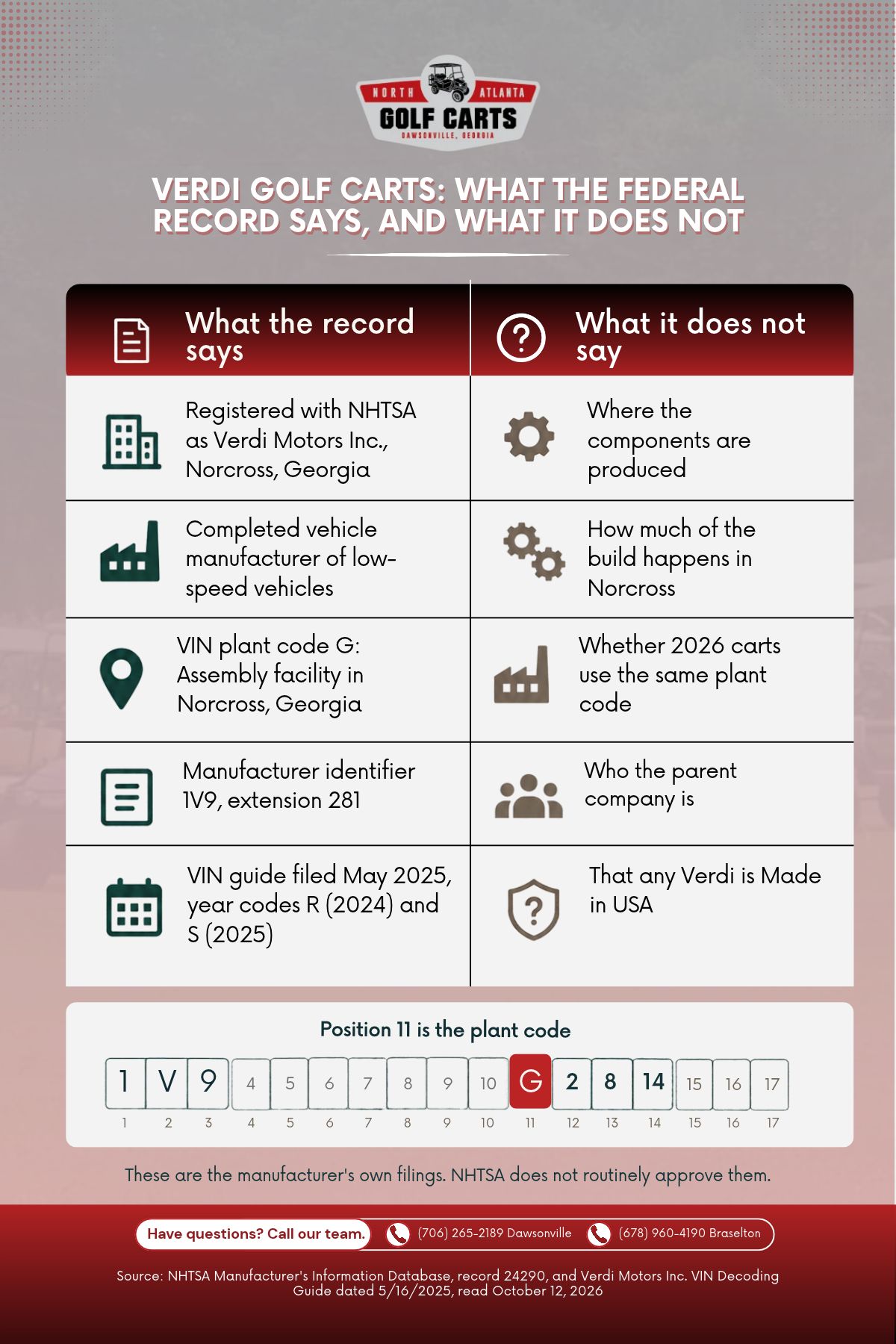
Verdi Motors Inc. is registered with the National Highway Traffic Safety Administration (NHTSA) as a completed vehicle manufacturer of low-speed vehicles, at an address in Norcross, Georgia. The VIN decoding guide Verdi filed with NHTSA in May 2025 says the eleventh character of a Verdi VIN is G, and that G stands for an assembly facility in Norcross, Georgia. Those filings are the manufacturer’s own statements, and NHTSA does not routinely approve them. The public record does not show where Verdi’s components are produced, how much of the build happens in Norcross, or who the parent company is. Assembly in Georgia is also a narrower claim than “Made in USA”, which federal rules reserve for products whose parts are all or virtually all American. A buyer in Buford, Cumming or Dawsonville can check any single car by reading its VIN and its certification label.
What Does the Federal Record Say About Verdi?
Two federal filings carry the answer, and both sit on NHTSA’s own servers. The agency’s manufacturer database lists Verdi Motors Inc. in Norcross, Georgia, as a completed vehicle manufacturer of low-speed vehicles. A separate VIN decoding guide, filed by Verdi in May 2025, describes the plant code in every Verdi VIN as an assembly facility in Norcross. Neither filing names a country or a supplier for the parts.
Here is what NHTSA’s manufacturer record for Verdi Motors Inc. showed when we read it on October 12, 2026.
| Field in the NHTSA record | What it shows for Verdi |
|---|---|
| Manufacturer name | VERDI MOTORS INC. |
| Common name | Verdi |
| Address | 5964 Peachtree Corners E, Suite G, Norcross, Georgia 30071 |
| Manufacturer type | Completed Vehicle Manufacturer |
| Vehicle type | Low Speed Vehicle (LSV), 3,000 lb or less |
| Vehicle description | “Electric low-speed vehicle (golf cart style), fully assembled and certified to meet FMVSS requirements” |
| Makes and models | Aspen, Malibu |
| Action history | Two entries, dated 4/9/2025 and 5/19/2025 |
| Parent company | Blank |
| Production start date | Blank |
FMVSS is the Federal Motor Vehicle Safety Standards. The words in that description are Verdi’s, typed into a federal form.
Why that address is a company address
The filing exists because federal rule 49 CFR Part 566 requires every motor vehicle manufacturer to identify itself to NHTSA. Read the list of what it asks for. A manufacturer has to give its full corporate name, its “residence address” and a description of each type of vehicle it makes, no later than 30 days after it begins manufacture.
A factory location is not on that list. So the Norcross address in the table tells you where the company can be found. On its face, it does not tell you where a car is put together.
The VIN guide is where assembly comes up
The second filing is more specific. Any maker of vehicles with a 17-character VIN has to send NHTSA the information needed to decode it, and Verdi’s submission is a one-page VIN decoding guide held on NHTSA’s server, carrying a letter date of 5/16/2025.
| VIN position | Characters | Meaning in Verdi’s guide |
|---|---|---|
| 1 to 3 | 1V9 | World manufacturer identifier, Verdi Motors Inc. |
| 4 | A or M | Series: A is Aspen, M is Malibu |
| 5 | 1 or 2 | Body style: all forward seats, or traditional layout |
| 6 | B | Restraints: 3-point seat belts |
| 7 | 6 or 4 | Motor: 5 kW AC or 4 kW AC |
| 8 | L | Lithium battery |
| 9 | Varies | Check digit |
| 10 | R or S | Model year: R is 2024, S is 2025 |
| 11 | G | Plant code: “Assembly facility in Norcross, Georgia” |
| 12 to 14 | 281 | Identifier extension for Verdi Motors Inc. |
| 15 to 17 | 000 to 999 | Serial number |
Position 11 answers the question in this article’s title. It is the only place in either filing where the word assembly is attached to a town.
Why the Word “Manufacturer” Settles Less Than It Seems
Federal vehicle rules use “manufacturer” more broadly than most shoppers do. The VIN rule, published as 49 CFR Part 565 on govinfo.gov, defines a manufacturer as a person “manufacturing or assembling motor vehicles” or “importing motor vehicles or motor vehicle equipment for resale.” All three activities earn the same word.
That is why “manufacturer of record” and “made in” are different claims. A company could hold a manufacturer record at a Georgia address under any of those three descriptions. The manufacturer record by itself would look the same.
The plant code is narrower. The same rule says the eleventh VIN character “shall represent the plant of manufacture,” and it defines that plant as “the plant where the manufacturer affixes the VIN.” Put the rule and the guide side by side, and you get a precise statement: Verdi has told NHTSA that the plant where it affixes the VIN is its assembly facility in Norcross.
Two limits come with it. The rule doesn’t say how much work must happen at that plant. And the filing is self-reported: Part 565 says the agency “will not routinely provide written approvals of these submissions.” We read it as Verdi’s declaration to a regulator, which is worth a lot more than a sales brochure and somewhat less than an audit.
What the Public Record Does Not Say
Plenty. These are the gaps we could not close from any document we were able to read.
- Where the frame, body panels, motor, controller, and lithium pack are produced. Neither filing names a supplier or a country.
- How much of the build happens in Norcross. “Assembly facility” covers a wide span of work, and the record does not narrow it.
- Anything about 2026 carts. Verdi’s guide lists year codes R and S only. The federal year table assigns T to 2026, and NHTSA’s submission search returned a single Part 565 filing for Verdi.
- Who owns the company? The parent company field is blank.
- A “Made in USA” claim. Neither filing makes one.
We also read Verdi’s own website, including its About page, its home page, both model pages, its parts page, and its PGA Show page. None of them state where the carts are built, and none print a country of origin. They describe the company’s years of experience and give the same Norcross street address as the federal record.
You will find pages online that name a country for Verdi’s parts with total confidence. None that we read pointed to a document, so we are not repeating them here.
| The record says | The record does not say |
|---|---|
| Verdi Motors Inc. is registered with NHTSA at a Norcross, Georgia address | Where the components are produced |
| It is a completed vehicle manufacturer of low-speed vehicles | How much of the build happens in Norcross |
| Its VIN plant code G means “Assembly facility in Norcross, Georgia” | Whether 2026 carts use the same plant code |
| Its identifier is 1V9 with the extension 281 | Who the parent company is |
| Verdi describes its carts as “fully assembled and certified to meet FMVSS requirements” | That any Verdi is “Made in USA” |
Is Assembled in Norcross the Same as Made in USA?
No. “Made in USA” is a legal claim with a three-part test, and assembly is only the first part. The Federal Trade Commission’s Made in USA Labeling Rule, 16 CFR Part 323, makes it unlawful to label a product that way unless “the final assembly or processing of the product occurs in the United States, all significant processing that goes into the product occurs in the United States, and all or virtually all ingredients or components of the product are made and sourced in the United States.”
The rule counts “manufactured,” “built,” and “produced” in the United States as the same unqualified claim. The filing asserts none of them. It says assembly, in Norcross, and stops.
Customs law fills in a little more. Under 19 CFR 134.11, every article of foreign origin imported into the United States has to be marked with the English name of its country of origin, so that the “ultimate purchaser” can see it. A related definition says that when an imported part is used in manufacturing and substantially transformed, the manufacturer may count as that ultimate purchaser. In plain terms, a part’s origin mark is not guaranteed to reach you on a finished vehicle.
When a mark does appear on a component, it speaks for that component and nothing else.
How to Check the Verdi in Front of You
The record covers the brand. A VIN covers one car, and you can read it yourself.
- Find the VIN: For a low-speed vehicle, Part 565 puts it inside the passenger compartment, readable through the glazing from a viewpoint outside the vehicle beside the left windshield pillar, in characters at least 4 mm high.
- Count 17 characters: The letters I, O and Q are never used, so a character that looks like one of them is a 1 or a 0.
- Read positions 1 to 3: The identifier for Verdi is 1V9. A 9 in the third position always signals a six-character identifier, so positions 12 to 14 should read 281.
- Read position 10: R is 2024, and S is 2025 in Verdi’s guide. The federal table gives T for 2026.
- Read position 11: G is the Norcross assembly facility in the guide on file. Any other letter means a plant the public guide does not list, and the seller should be able to explain it.
- Find the certification label: Under 49 CFR 567.4, it has to say “Manufactured By” or “Mfd By” followed by the full corporate name of “the actual assembler of the vehicle”, then the month and year of manufacture, the weight ratings, a conformity statement, the VIN, and the vehicle type.
- Look at the big components: Check the battery pack, the charger, and the tires for their own maker and origin marks.
Two details that are easy to miss
The label rule lists door-related spots first: the hinge pillar, the door-latch post, the door edge. An open-sided cart has none of those. The rule’s fallback is the left side of the instrument panel, so start there.
The name is the other one. NHTSA’s record says “Verdi Motors Inc.” with an s, while the footer of the maker’s website and our own inventory listings say “Verdi Motor Inc.” The street address matches. Search either spelling, and you will land on the same company.
The date on that label has a defined meaning as well. The rule says the month and year of manufacture is “the time during which work was completed at the place of main assembly of the vehicle.” The rule does not require the label to print the place. It does tie the date to it.
The weight ratings on the label work the way they do on any cart, and we walk through that arithmetic in what a utility cart can carry. Buying a used cart from one of the older brands is a different exercise, because Club Car, Yamaha, and E-Z-GO each use their own serial formats; our used cart checklist covers those.
What a Georgia Address Changes for a North Georgia Buyer
Less than the map suggests, and more than nothing. Verdi’s filed address geocodes to Gwinnett County in the Census Bureau’s address tool. Our Buford store on Thompson Mill Road falls in Hall County, and our Dawsonville store on Highway 53 is in Dawson County. For a shopper in Cumming or Gainesville, that means the company answering for the cart has a Georgia street address, and its website lists weekday office hours there.
What an address cannot do is promise parts. The maker’s site says it stocks parts for the dealers it supplies and lists items such as brakes, mirrors, chargers, and a 5 kW AC motor as in stock. That is the maker’s statement. Ask whoever sells you the cart how a parts order and a warranty claim travel between your driveway and Norcross, and get the answer in writing.
Where Verdi Sits Beside the Brands We Are Factory Authorized For
Our factory authorizations are Club Car, E-Z-GO, and Star EV. Our inventory also includes Verdi Motor Inc., along with Denago EV and Yamaha. We say it that way on purpose, because a factory authorization and a brand in inventory are different relationships, and a buyer deserves to know which one applies.
The maker’s website publishes these figures for its current lineup.
| Model on Verdi’s site | Seating | Lithium battery listed | Range claim | Top speed listed |
|---|---|---|---|---|
| Aspen S4 | 4 | 51.7V 105Ah | Up to 40 miles | 25 mph |
| Aspen S6 | 6 | 51.7V 150Ah or 105Ah | Up to 65 miles | 25 mph |
| Aspen F4 | 4, all forward-facing | 51.7V 150Ah or 105Ah | Up to 65 miles | 25 mph |
| Aspen F6 | 6, all forward-facing | 51.7V 150Ah or 105Ah | Up to 65 miles | 25 mph |
Those are the maker’s claims, and the range figures carry the words “up to”.
The 25 mph figure matters legally. Federal rules define a low-speed vehicle as a four-wheeled vehicle that can exceed 20 mph but not 25 mph, with a gross vehicle weight rating under 3,000 lb. That is the vehicle type on Verdi’s NHTSA record, and it puts the cart in a different Georgia category than a golf car, which changes how the cart gets insured.
A lithium pack is standard across the lineup, so the long-run battery math in our lithium and lead-acid cost comparison applies. And if you are weighing a newer name against the established ones, read how Club Car, E-Z-GO and Yamaha differ before you decide what you are giving up or gaining.
A last observation from the filing. The six-character identifier is the format Part 565 assigns to a low-volume manufacturer, which the rule defines as one making fewer than 1,000 vehicles of a given type each year. Small is not a flaw. It is a reason to ask harder questions about parts supply than you would ask of a brand with decades of dealers behind it.
Read a Verdi VIN at Our Dawsonville or Buford Store
Pick any Verdi on a lot, ours or anyone’s, and read the eleventh character before you talk price. If it is a G, the maker has told the federal government that car came through its assembly facility in Norcross. If it is anything else, or the tenth character is a T, the guide on file does not cover it yet, and the seller owes you an explanation. Then find the certification label and read the name after “Manufactured By”.
Verdi carts are part of the inventory at North Atlanta Golf Carts, next to the three brands we hold factory authorizations for, at our stores in Dawsonville and Buford. Bring this page with you. The VIN table above is the whole decoder.